Your Encoder Questions, Answered Honestly

Feb 12, 2026

Encoders are a traditionally expensive part of broadcasting. Choosing the right encoder can future-proof your mission-driven streaming setup.

Your Encoder Questions, Answered Honestly

Feb 12, 2026

Encoders are a traditionally expensive part of broadcasting. Choosing the right encoder can future-proof your mission-driven streaming setup.

You've got cameras, switchers, graphics. Everything's dialed in. But when someone asks about your encoder, things get fuzzy. 

Let's clear that up. In this resource, we’ll look at common questions surrounding encoders in live broadcasting and some of the lessons the Sardius Media team has learned deploying and using encoders in high-stakes, mission-driven broadcasting scenarios in the field.

Why Does Your Encoder Actually Matter?

Your encoder connects two key parts of your broadcasting setup. It is the bridge between your control room and your audience's screens.

Everything you produce has to be compressed and packaged into a format that streams reliably across the internet. Every camera angle, every graphic overlay, every moment of your live event. That's your encoder's job. 

It takes raw video and translates it into deliverable formats. In the industry, we talk about "glass to glass," the full journey from your camera lens to your viewer's device. Your encoder is the critical handoff point in that chain.

This central role means a subpar encoder creates problems, like:

  • Quality degradation during high-motion moments, when your audience wants to see crisp visuals.

  • Latency limitations when your specific workflow requires a tighter sync than your encoder can deliver.

  • Compatibility gaps when platforms update, and your hardware can't keep pace.

  • Reliability concerns during mission-critical broadcasts when failure isn't an option.

If you're streaming casually, basic gear gets the job done. But when your broadcasts matter, when there's an audience, stakeholders, or a live event counting on you, your encoder becomes the linchpin. It isn’t a nice add-on. It’s central to success.

So Which Encoder Should You Actually Get?

This depends on the size and complexity of your workflow. For professional streaming operations, solutions built on AWS Elemental MediaLive Anywhere (EMLA) are worth serious consideration. They’re a favorite at Sardius Media, and with good reason.

The Traditional Encoder Challenge

Most professional encoders follow a predictable pattern. You invest in solid hardware, and it works great for about two to four years. Then codec standards shift. Streaming protocols evolve. Your equipment becomes a bottleneck.

Many legacy encoders are single-purpose, locking you into one codec with no upgrade path. When newer standards become the expectation, you're shopping again.

What Makes EMLA Different

AWS built EMLA as encoding software designed to evolve. As new codecs gain traction (HEVC now, AV1 as it matures), AWS pushes updates. You don't replace hardware. You update software. That is a much smaller (and more cost-effective) hurdle.

The challenge? EMLA is powerful software, but software alone doesn't go in your rack. You need properly spec'd hardware to run it, plus configuration expertise to make it operational.

Sardius EMLA: The Complete Package

This is where Sardius comes in. 

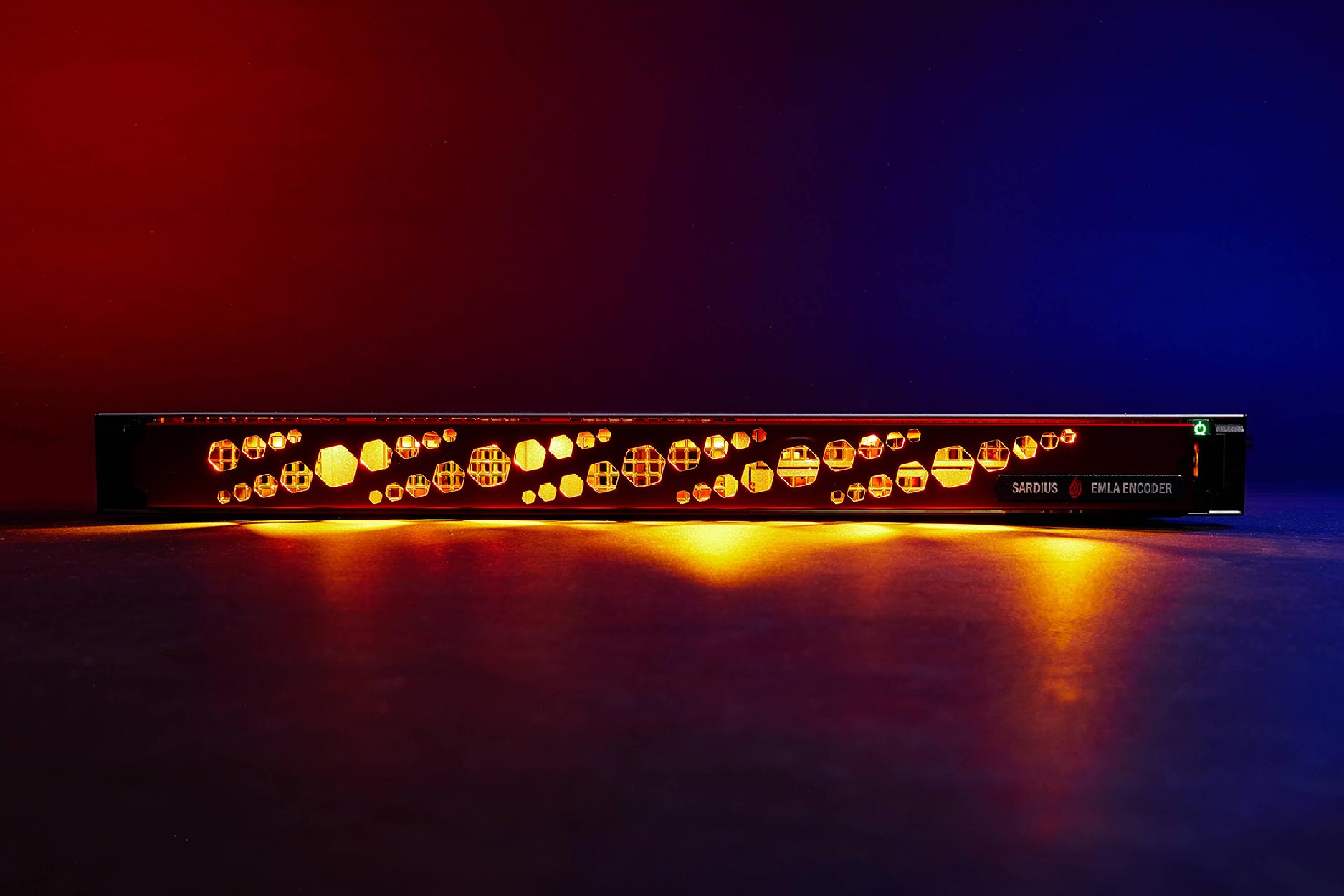
Sardius EMLA pairs AWS's EMLA software with purpose-built hardware in a complete encoder solution. It's a partnership between Sardius and AWS that takes the complexity out of deploying EMLA. We give you a rack-ready encoder backed by the same technology powering NFL broadcasts and the Olympics.

The software-forward approach extends your relevant lifespan from that typical two-to-four-year window closer to five-to-ten years. That means you keep the same hardware but get ongoing access to evolving capabilities.

The Practical Upside to Sardius + EMLA

Sardius EMLA handles adaptive bitrate encoding natively across multiple delivery formats. HLS makes up a significant share of professional streaming delivery, but you're not boxed in. Your stream automatically adjusts quality based on viewer bandwidth, which is critical for reaching audiences on inconsistent connections without buffering issues.

When it comes to costs, the initial investment is comparable to traditional professional encoders. The ROI difference shows up in year three, year five, year seven, when you're still broadcasting at current standards instead of budgeting for a replacement.

When Other Options Make Sense

Sardius EMLA isn't the only path. Haivision gear, for example, still has valid deployment scenarios, particularly for SRT workflows. 

While the Sardius team has had a lot of success with EMLA, it’s important to understand that it isn’t a one-size-fits-all answer. Getting the right encoder starts with understanding your operational requirements.

Premium Hardware + Evolving Software = Broadcasting Success

If streaming is central to your operation and you're tired of the equipment replacement cycle, Sardius EMLA is worth the conversation. It's not the cheapest option on day one, but it's often the smartest investment over the long run.

If you’re interested in a demo, reach out. Help our team understand your broadcasting vision. We can walk with you through the evaluation and decision process to see if an EMLA setup is right for you.

You've got cameras, switchers, graphics. Everything's dialed in. But when someone asks about your encoder, things get fuzzy. 

Let's clear that up. In this resource, we’ll look at common questions surrounding encoders in live broadcasting and some of the lessons the Sardius Media team has learned deploying and using encoders in high-stakes, mission-driven broadcasting scenarios in the field.

Why Does Your Encoder Actually Matter?

Your encoder connects two key parts of your broadcasting setup. It is the bridge between your control room and your audience's screens.

Everything you produce has to be compressed and packaged into a format that streams reliably across the internet. Every camera angle, every graphic overlay, every moment of your live event. That's your encoder's job. 

It takes raw video and translates it into deliverable formats. In the industry, we talk about "glass to glass," the full journey from your camera lens to your viewer's device. Your encoder is the critical handoff point in that chain.

This central role means a subpar encoder creates problems, like:

  • Quality degradation during high-motion moments, when your audience wants to see crisp visuals.

  • Latency limitations when your specific workflow requires a tighter sync than your encoder can deliver.

  • Compatibility gaps when platforms update, and your hardware can't keep pace.

  • Reliability concerns during mission-critical broadcasts when failure isn't an option.

If you're streaming casually, basic gear gets the job done. But when your broadcasts matter, when there's an audience, stakeholders, or a live event counting on you, your encoder becomes the linchpin. It isn’t a nice add-on. It’s central to success.

So Which Encoder Should You Actually Get?

This depends on the size and complexity of your workflow. For professional streaming operations, solutions built on AWS Elemental MediaLive Anywhere (EMLA) are worth serious consideration. They’re a favorite at Sardius Media, and with good reason.

The Traditional Encoder Challenge

Most professional encoders follow a predictable pattern. You invest in solid hardware, and it works great for about two to four years. Then codec standards shift. Streaming protocols evolve. Your equipment becomes a bottleneck.

Many legacy encoders are single-purpose, locking you into one codec with no upgrade path. When newer standards become the expectation, you're shopping again.

What Makes EMLA Different

AWS built EMLA as encoding software designed to evolve. As new codecs gain traction (HEVC now, AV1 as it matures), AWS pushes updates. You don't replace hardware. You update software. That is a much smaller (and more cost-effective) hurdle.

The challenge? EMLA is powerful software, but software alone doesn't go in your rack. You need properly spec'd hardware to run it, plus configuration expertise to make it operational.

Sardius EMLA: The Complete Package

This is where Sardius comes in. 

Sardius EMLA pairs AWS's EMLA software with purpose-built hardware in a complete encoder solution. It's a partnership between Sardius and AWS that takes the complexity out of deploying EMLA. We give you a rack-ready encoder backed by the same technology powering NFL broadcasts and the Olympics.

The software-forward approach extends your relevant lifespan from that typical two-to-four-year window closer to five-to-ten years. That means you keep the same hardware but get ongoing access to evolving capabilities.

The Practical Upside to Sardius + EMLA

Sardius EMLA handles adaptive bitrate encoding natively across multiple delivery formats. HLS makes up a significant share of professional streaming delivery, but you're not boxed in. Your stream automatically adjusts quality based on viewer bandwidth, which is critical for reaching audiences on inconsistent connections without buffering issues.

When it comes to costs, the initial investment is comparable to traditional professional encoders. The ROI difference shows up in year three, year five, year seven, when you're still broadcasting at current standards instead of budgeting for a replacement.

When Other Options Make Sense

Sardius EMLA isn't the only path. Haivision gear, for example, still has valid deployment scenarios, particularly for SRT workflows. 

While the Sardius team has had a lot of success with EMLA, it’s important to understand that it isn’t a one-size-fits-all answer. Getting the right encoder starts with understanding your operational requirements.

Premium Hardware + Evolving Software = Broadcasting Success

If streaming is central to your operation and you're tired of the equipment replacement cycle, Sardius EMLA is worth the conversation. It's not the cheapest option on day one, but it's often the smartest investment over the long run.

If you’re interested in a demo, reach out. Help our team understand your broadcasting vision. We can walk with you through the evaluation and decision process to see if an EMLA setup is right for you.

Book a Demo

Our broadcasting experts are here to ensure your experience with us is smooth and successful. Reach out, and together, we can make sure you’re confident and well-supported every time you go live.

Contact us

Book a Demo

Our broadcasting experts are here to ensure your experience with us is smooth and successful. Reach out, and together, we can make sure you’re confident and well-supported every time you go live.

Contact us

Book a Demo

Our broadcasting experts are here to ensure your experience with us is smooth and successful. Reach out, and together, we can make sure you’re confident and well-supported every time you go live.

Contact us